


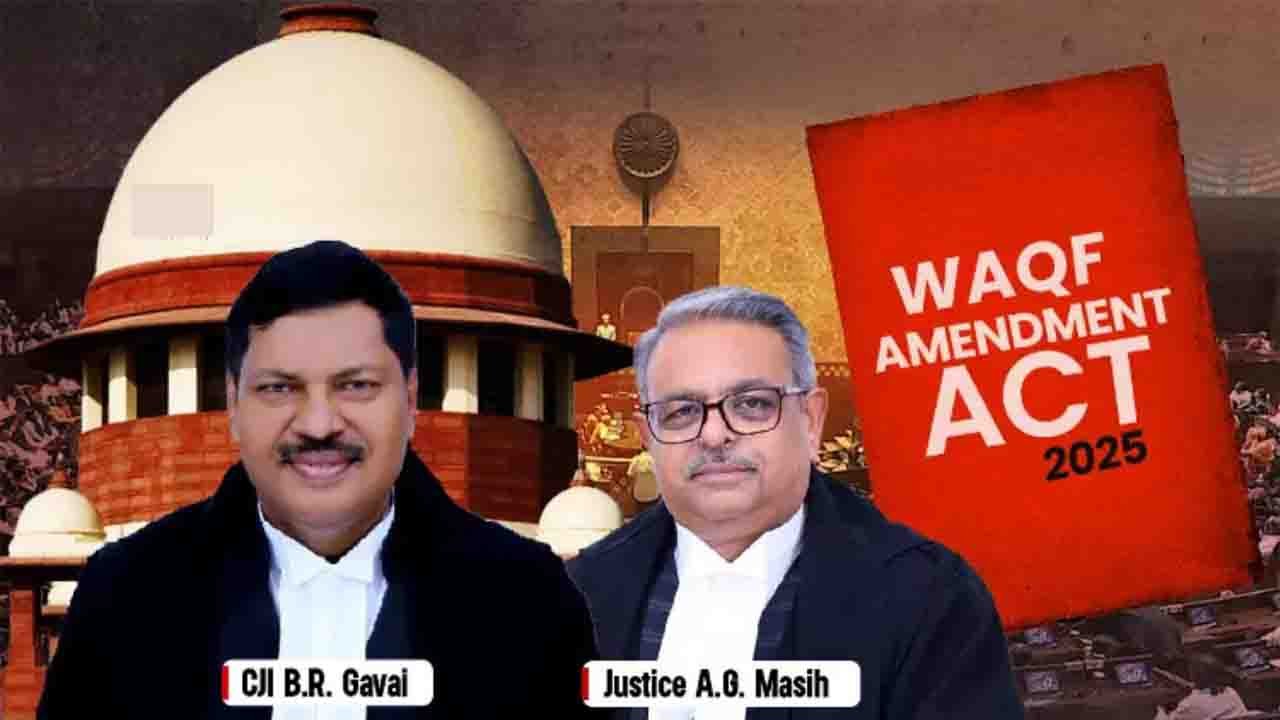
Waqf Amendment Act: New Delhi, Sept. 15: The Supreme Court on Monday put on hold several contentious provisions of the Waqf (Amendment) Act, 2025, while hearing multiple petitions challenging the constitutional validity of the law.
The bench of Chief Justice of India BR Gavai and Justice AG Masih noted that certain clauses, if implemented without safeguards, could lead to arbitrary action and affect the separation of powers.
Waqf Amendment Act | Five-Year Condition for Creating Waqf Put on Hold
The Court stayed the provision under Section 3(1)(r), which required a person to be a practicing Muslim for five years before creating a waqf.
The bench observed that without a clear mechanism to determine compliance, the clause could result in “arbitrary exercise of power.” The stay will remain until state governments frame rules on the matter.
The bench also intervened in provisions under Section 3C. The proviso that a waqf property will not be treated as such until a designated government officer submits a report on encroachment was stayed.
Additionally, the Court suspended Section 3C(3) and Section 3C(4), which empowered the officer and state governments to alter revenue records and direct corrections in Waqf Board records.
CJI Gavai underlined that allowing the executive to determine citizens’ rights went against the principle of separation of powers.
Until a final determination under Section 83 by the Waqf Tribunal, the Court clarified, the status of waqf properties will remain unaffected. However, it directed that no third-party rights be created during the pendency of such proceedings.
Waqf Amendment Act | Non-Muslim Members on Waqf Boards Allowed with Restrictions
The Court declined to stay provisions allowing the nomination of non-Muslim members to the Central Waqf Council and State Waqf Boards but imposed limits.
For the Central Council, it directed that not more than four of the 20 members should be non-Muslims, and for State Boards, not more than three out of 11.
It further stated that, as far as possible, the Chief Executive Officer of a Waqf Board should be from the Muslim community.
The Court did not interfere with the registration requirement for waqfs, holding it was not a new condition since it existed in earlier enactments. However, it extended the deadlines for compliance, with details to be specified in the final order.
The bench clarified that its observations were prima facie and subject to a final hearing. The petitions, filed by a wide spectrum of political parties, religious organizations, and individuals, contest sweeping changes introduced by Parliament in 2025.
Petitioners include AIMIM MP Asaduddin Owaisi, AAP MLA Amanatullah Khan, Jamiat Ulema-i-Hind President Arshad Madani, and several political parties like DMK, CPI, RJD, SP, TMC, and IUML.
On the other hand, BJP-led states such as Assam, Rajasthan, Chhattisgarh, Uttarakhand, Haryana, and Maharashtra have supported the law.
Recently, Kerala also filed an intervention backing the amendments.
Broader Provisions Under Challenge
Apart from the five-year clause and encroachment-related provisions, several other amendments have been challenged. These include invalidating waqfs created over ASI-protected monuments, restrictions on creating waqfs in scheduled areas, limiting women’s representation to two members in the Waqf Council and Boards, diluting the concept of waqf-alal-aulad, and renaming the Waqf Act, 1995 as the “Unified Waqf Management, Empowerment, Efficiency and Development Act.”
Petitioners have also contested the provision allowing appeals against Tribunal orders and the removal of the long-recognized concept of “waqf by user.” These sweeping changes, according to petitioners, dilute established protections and could impact the community’s right to manage its religious endowments.
The Court had reserved its order on May 22 after three days of hearings, and Monday’s directions are interim in nature, pending a full hearing on the constitutional validity of the Act.

Now you can get the latest stories from Indtoday on Telegram every day. Click the link to subscribe. Click to follow Indtoday’s Facebook page, Twitter, and Instagram. For all the latest Hyderabad News updates