

Warangal/Hyderabad. Nov 21 (Maxim News): A community initiative at Gorrekunta near Warangal is exploring ways to convert discarded fish-market material into valuable agricultural and animal-feed products.
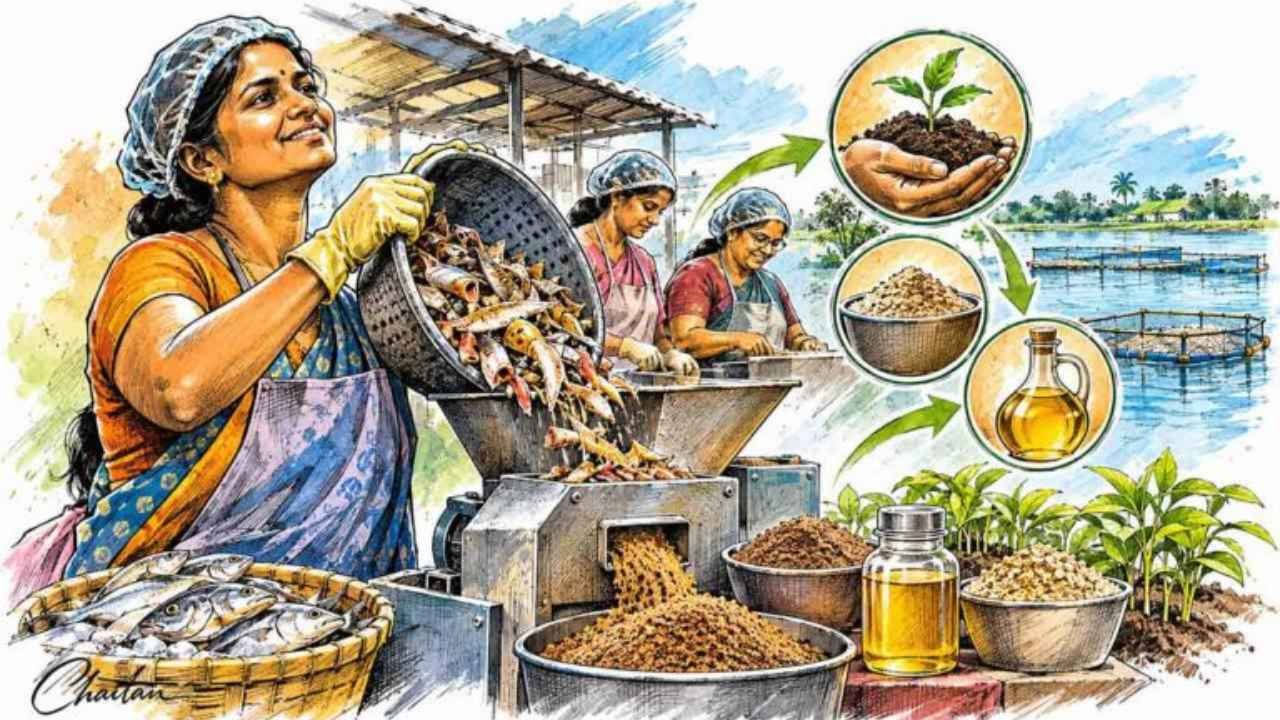
The project aims to turn fish heads, entrails, scales, bones, skin and other processing residues into Fish Amino Acid (FAA), organic compost and fish protein powder.
The initiative could reduce fish-market waste while creating additional income opportunities for fishing communities, particularly fisherwomen.
A Small Beginning with a Larger Vision
Around three years ago, an initiative began at Gorrekunta to help local fisherwomen convert fish waste into useful agricultural products.
With the initiative of this writer and technical support from Prakriti Environment Society (PES), the Gorrekunta Fisher-women Cooperative Society started producing Fish Amino Acid and organic fish compost on a small scale.
The process involved mixing fresh fish waste with equal quantities of jaggery. The mixture was then fermented for approximately 45 days and stirred regularly.
After fermentation, the liquid was separated, filtered and bottled. The remaining solid material was retained for further processing into organic compost.
The experiment gradually developed into a community-level activity. Fisherwomen gained practical experience, while farmers showed interest in the products.
Laboratory testing of the existing Fish Amino Acid recorded 0.58 per cent nitrogen, 5.13 per cent calcium and 0.16 per cent potassium. The sample also contained zinc and trace minerals.
The findings indicated a calcium-rich composition. However, further technical improvements are required to enhance and standardise its nutrient profile.
The initiative has now attracted the attention of the Warangal district administration. The District Collector and District Fisheries Officer have responded positively to a proposal for expanding the venture.
Local Parkal MLA Revuri Prakash Reddy has also encouraged the initiative. The district administration has proposed allotting approximately two acres at Gorrekunta free of cost.
Three Products from Fish Waste
The proposed facility aims to move beyond small-scale production of liquid fertiliser and compost. It plans to develop an integrated fish-waste processing unit with an initial capacity of one tonne per day.
The project will focus on three products, subject to scientific assessment and appropriate processing.
Fish Amino Acid: A Liquid Agricultural Input
Fish Amino Acid is produced through the controlled fermentation of fish material. It contains organic matter and nutrients that may support plant growth and soil biological activity.
Its agricultural performance depends on its composition, quality and application. Standardised fermentation, filtration and quality-control systems can help improve product consistency.
Research institutions could support better fermentation techniques, enzymatic hydrolysis and suitable formulations. The objective is to develop a scientifically validated agricultural input.
Organic Fish Compost: Turning Residues into Manure
The solid material remaining after liquid extraction can be processed into organic fish compost.
The proposal involves mixing the residue with suitable agricultural waste and carbon-rich organic materials. Controlled composting and approximately six months of maturation could produce organic manure.
This process could recover nutrients from discarded fish material. It may also offer farmers an alternative organic soil input.
Fish Protein Powder: Recovering Nutritional Value
The third proposed product could create opportunities in aquaculture and animal-feed industries.
Fish waste contains proteins, particularly in flesh, heads, skin and other protein-bearing portions. Suitable material can be segregated, dried, ground and processed into fish protein meal or powder.
An initial technical assessment of a dried fish-waste sample recorded approximately 41 per cent crude protein. However, the assessment also identified a high calcium-to-phosphorus ratio and potential microbial and heavy-metal concerns.
Therefore, the existing powder cannot be recommended as a human dietary supplement. The immediate opportunity is to develop a properly processed, tested and certified feed-grade product.
Institutions such as ICAR-Central Institute of Fisheries Technology (CIFT) and ICAR-Central Institute of Freshwater Aquaculture (CIFA) could assist with processing methods, nutritional standards and quality-control protocols.
The three products offer different commercial opportunities. However, the project must scientifically determine how incoming fish waste should be allocated among them.
The same material cannot be counted twice. Pilot trials must establish product yields, processing requirements and production costs.
Building a Circular Economy Around Fisheries
The larger significance of Gorrekunta lies in its approach to resource recovery.
India’s fisheries sector has focused on increasing production, improving marketing, expanding cold storage and promoting exports. However, the material discarded after fish processing also deserves attention.
The Food and Agriculture Organization (FAO) recognises circular-economy approaches as a way to reduce losses. These approaches can convert fish-processing by-products into fishmeal, fertilisers, animal feed and other useful products.
The Gorrekunta proposal aims to apply this approach through a community-owned enterprise.
The liquid fraction could be processed into Fish Amino Acid. Selected protein-rich material could be used for protein recovery, while suitable remaining solids could become compost.
Proper treatment and management of process water would also be essential.
Such a system could improve fish-market sanitation, reduce environmental nuisance and generate additional income. It could also create stronger economic links between fisheries, agriculture and animal nutrition.
New Opportunities for Fisherwomen
One of the initiative’s most important features is the central role assigned to fisherwomen.
Women are actively involved in fish vending, cleaning, processing and marketing. However, their participation in organised value addition and manufacturing remains limited in many areas.
A properly supported processing enterprise could help them become owners and managers of a manufacturing unit.
The proposed two-acre facility could accommodate fermentation vessels, processing machinery, composting yards and drying equipment. It could also include packaging sections, storage facilities and a basic quality-control laboratory.
At an intake capacity of one tonne per day and around 300 working days annually, the facility could process approximately 300 tonnes of fish waste.
The preliminary project estimate stands at Rs 1.50 crore. However, adding the fish-protein processing section will require a revised technical and financial assessment.
The model could also be replicated in other fish-producing districts. Fisherwomen cooperatives, fishermen’s societies, self-help groups and rural entrepreneurs could establish similar enterprises.
Local fish markets could supply the raw material. Meanwhile, farmers, aquaculture operators and animal-feed manufacturers could become potential customers.
Scientific Support Will Be Essential
The project’s commercial success will depend on scientific validation and professional management.
The fermentation process must be standardised, and product quality must remain consistent. Compost must meet applicable organic-manure specifications.
Similarly, the fish protein product must satisfy relevant feed-safety and nutritional standards.
ICAR-CIFT, ICAR-CIFA, ICAR-CIFRI and ICAR-CIFE could support the initiative. Agricultural and veterinary universities could also contribute technical expertise.
The National Fisheries Development Board (NFDB), Telangana Fisheries Department and Union Ministry of Fisheries, Animal Husbandry and Dairying could explore suitable technical and financial support under applicable programmes.
The Agriculture and Horticulture Departments could facilitate field demonstrations and market linkages for Fish Amino Acid and compost.
Aquafeed and animal-feed manufacturers could evaluate the commercial potential of the protein product.
A phased approach would help reduce investment risks. The project could build on its existing small-scale experience before introducing additional products after scientific validation.
Can Gorrekunta Become a National Model?
India’s fisheries sector has made significant progress in production, aquaculture, exports and infrastructure. However, fish-waste utilisation remains an area with considerable potential.
World Fisheries Day should also encourage technological innovation and new income opportunities for fishing communities.
The Gorrekunta initiative brings these objectives together. It shows how discarded material could become an economic resource and how fisherwomen could participate in value-added manufacturing.
The project’s wider vision extends beyond waste disposal. It seeks to connect fisheries with agriculture, livestock and aquaculture through resource recovery.
Perhaps the future of fisheries development should not be measured only by how much fish India produces and sells. It should also consider how efficiently every part of the harvested resource is utilised.
The fish sold in markets feeds people. Recovered material could support farms, livestock and aquaculture while creating new livelihoods.
From pond to farm and from waste to wealth, Gorrekunta offers a promising approach to resource recovery and rural entrepreneurship.
Now you can get the latest stories from Indtoday on Telegram every day. Click the link to subscribe. Click to follow Indtoday’s Facebook page, Twitter, and Instagram. For all the latest Hyderabad News updates and Follow us on GoogleNews and Follow Our Youtube Channel on Google