

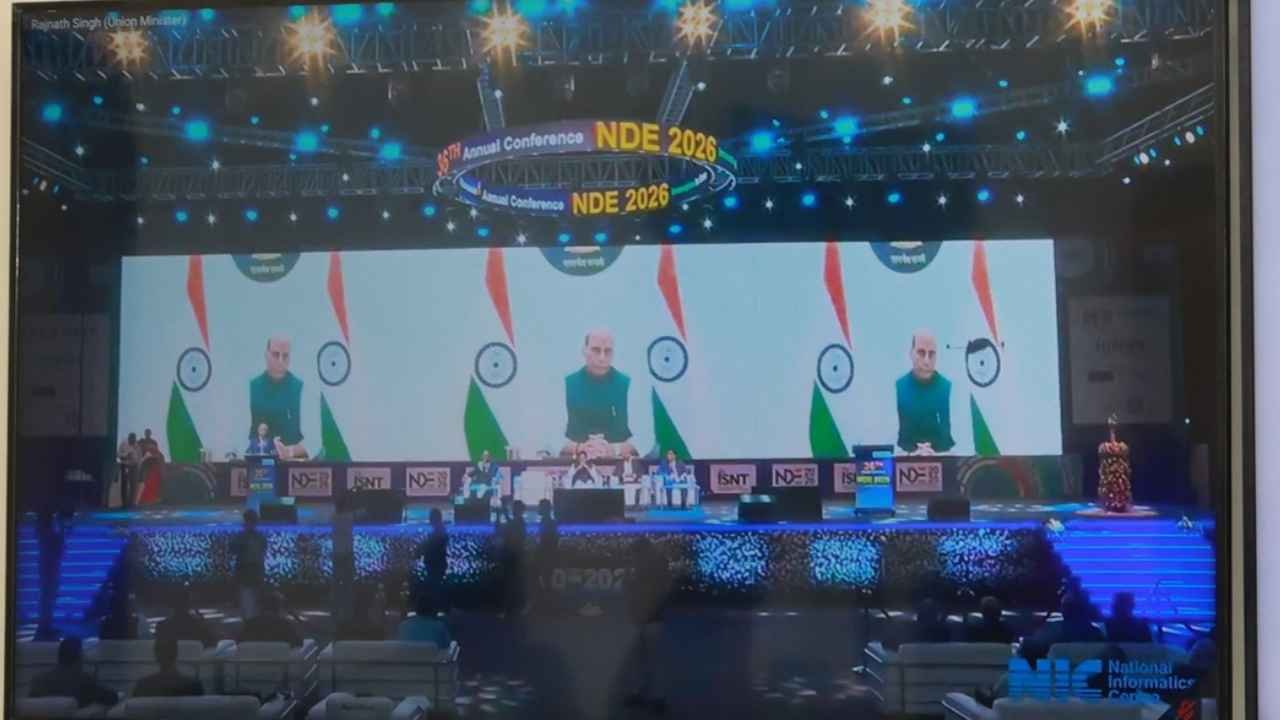
Hyderabad, Nov. 16: Defence Minister Rajnath Singh has called for strengthening India’s indigenous Non-Destructive Testing (NDT) capabilities to boost defence preparedness and technological self-reliance. He said India must move beyond adopting advanced technologies and become a developer, innovator and global leader.
Virtually addressing the 36th Annual Conference on Non-Destructive Evaluation and Enabling Technologies and the 15th International Symposium on Non-Destructive Testing in Aerospace in Hyderabad on November 15, he stressed the need for reliable inspection systems and consistent quality assurance.
He said there could be no compromise on the accuracy and integrity of testing results, particularly in strategic defence applications. He also called for developing indigenous inspection technologies, specialised sensors, evaluation equipment and software to reduce technological dependence.
Rajnath Singh Highlights Role of NDT in Defence and Aerospace
Explaining the importance of NDT, Rajnath Singh said the technology helps examine materials, components and structures without damaging them. He compared the process to medical ultrasound and X-rays, which detect internal conditions without surgery.
He said every critical material, component and manufacturing process in India’s increasingly sophisticated defence systems must meet the highest quality standards. Hidden defects could affect operational readiness, increase maintenance needs and reduce equipment life. In critical situations, they could also jeopardise mission success.
The Defence Minister urged the industry to shift from identifying defects to preventing them through quality checks at every manufacturing stage. He added that quality in missiles, aircraft, naval platforms and spacecraft was directly linked to operational reliability and national security.
Rajnath Singh described defence self-reliance as a strategic necessity. He cited progress in missile development, naval platforms, aerospace engineering, radar systems and space applications. He also highlighted INS Vikrant, India’s first indigenous aircraft carrier, as a major milestone in the Aatmanirbhar Bharat initiative.
He referred to the Innovations for Defence Excellence (iDEX) and Technology Development Fund (TDF) as key initiatives supporting innovation and technological development.
The Minister also highlighted the growing role of Artificial Intelligence, Machine Learning, Robotics, advanced sensors, Digital Twins and Predictive Analytics in NDT. These technologies can improve inspection speed, consistency and structural health monitoring.
He called for integrating established inspection methods with advanced digital technologies. He urged Indian researchers and industries to develop indigenous solutions suited to the country’s strategic and industrial requirements.
Rajnath Singh also stressed collaboration among the Government, industry, academia and research laboratories. He called for coordinated efforts to strengthen technological advancement and strategic self-reliance.
The three-day conference, organised by the Indian Society for Non-Destructive Testing in Hyderabad, brought together more than 2,000 professionals, researchers, industry experts and students. The event focused on emerging NDT technologies, knowledge exchange and collaboration across sectors, including defence and aerospace.
Now you can get the latest stories from Indtoday on Telegram every day. Click the link to subscribe. Click to follow Indtoday’s Facebook page, Twitter, and Instagram. For all the latest Hyderabad News updates and Follow us on GoogleNews and Follow Our Youtube Channel on Google