




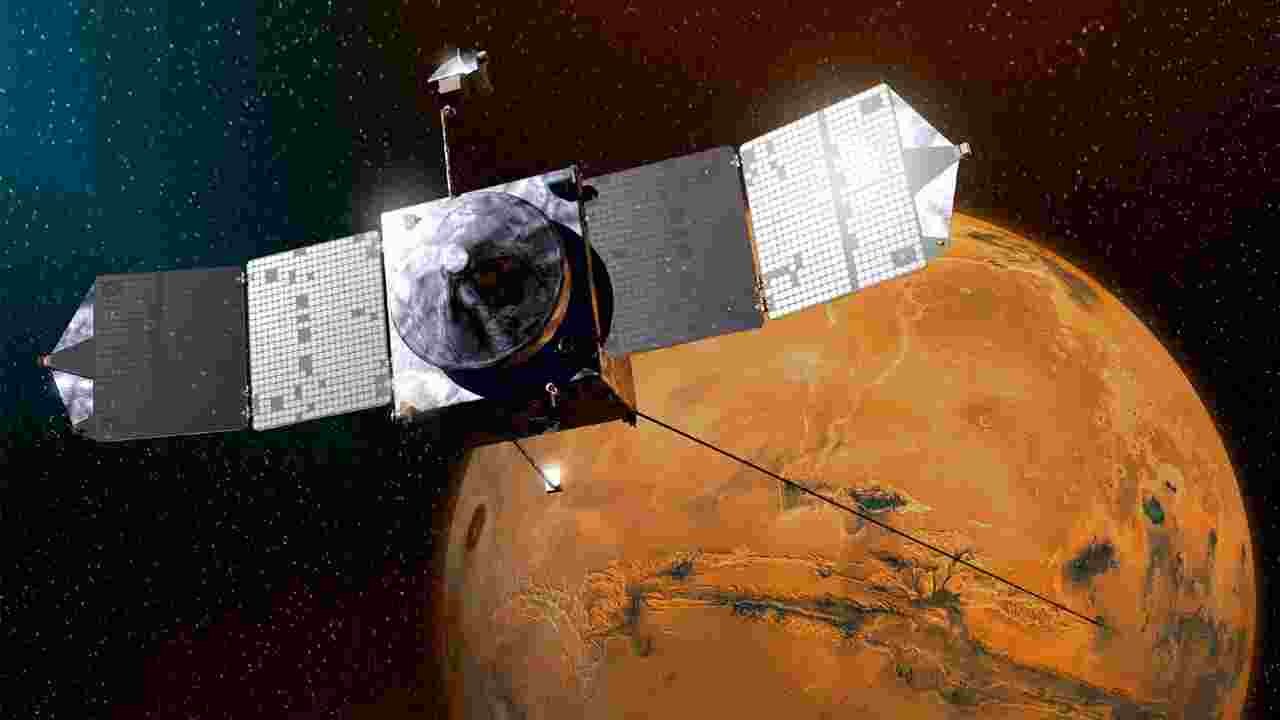
Los Angeles, June 5: NASA has officially concluded its MAVEN (Mars Atmosphere and Volatile Evolution) mission after losing contact with the spacecraft in December 2025, marking the end of an 11-year scientific exploration of Mars’ atmosphere.
The spacecraft, launched on November 18, 2013, successfully entered Martian orbit on September 21, 2014. It was NASA’s first mission dedicated to studying the upper atmosphere of Mars and understanding how the planet lost its atmosphere over time. Although initially planned for a one-year operation, MAVEN far exceeded expectations by functioning for more than a decade.
NASA said the spacecraft last communicated on December 6, 2025, shortly after it passed behind Mars and experienced an unexpected signal loss. Following this, the agency formed an anomaly review board in February to evaluate recovery options and determine the cause of the failure.
The board has now concluded that the spacecraft is not recoverable and can no longer perform its science and data relay functions. This finding is consistent with the mission team’s internal assessment.
Preliminary investigations suggest that MAVEN may have entered a high-rate spin condition after re-emerging from Mars’ shadow. This likely disrupted its trajectory and drained onboard power systems, resulting in a complete loss of communication.
NASA clarified that the exact cause of the anomaly is still under investigation, and a detailed final report is expected later this year.
With recovery no longer possible, NASA has begun formal procedures to decommission the mission. However, the agency confirmed that all scientific data collected by MAVEN will be preserved and made available to researchers studying planetary evolution and atmospheric loss.
Louise Prockter, Director of NASA’s Planetary Science Division, said MAVEN’s findings are crucial for understanding radiation conditions and preparing for future human missions to Mars.
Despite its end, MAVEN is widely regarded as a highly successful mission that significantly advanced knowledge of Mars’ atmospheric history and evolution. Its findings will continue to support future exploration and interplanetary mission planning.
Now you can get the latest stories from Indtoday on Telegram every day. Click the link to subscribe. Click to follow Indtoday’s Facebook page, Twitter, and Instagram. For all the latest Hyderabad News updates and Follow us on GoogleNews