


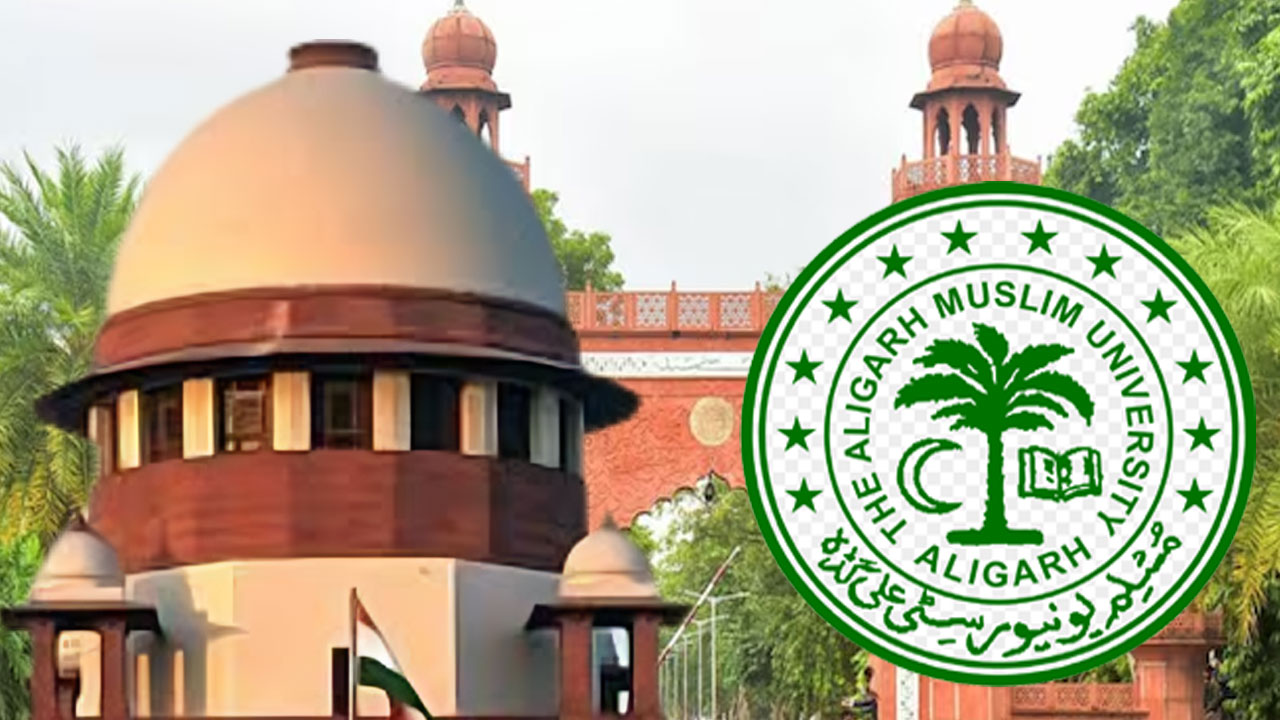
Delhi/Hyderabad, Nov 8 (Maxim News): Supreme Court in an appeal against Allahabad High Court’s Order in Naresh Agarwal (Dr.) v. Union of India, 2005, whereby, Aligarh Muslim University‘s (AMU) action of 50 percent seat reservation to postgraduate medical courses for Muslim candidates by claiming it to be a minority institution, was stuck down handheld that AMU cannot have an exclusive reservation because it is not a minority institution, the Seven – Judge Constitution Bench comprising of Dr. DY Chandrachud, CJ, Sanjiv Khanna, Surya Kant, JB Pardiwala, Dipankar Datta, Manoj Misra and Satish Chandra Sharma JJ 4:3 overruled the Five-Judge Bench verdict in S.Azeez Basha V.Union of India 1967 SCC OnLine SC 321, which held that an institution incorporated by a statute cannot claim to be a minority institution.
Click Here To Join Us On WhatsApp
Thus, Aligarh Muslim University as created by an Act of Parliament, is not a minority institution to be covered under Article 30 of the Constitution of India. Thus, the Court held that the minority status of an educational institute will not cease merely because the parliament enacts a law to regulate or regulate such an institute or that the institute is being administered by non-minority members. The issue of whether Aligarh Muslim University is a minority institution is now left to be decided by a regular bench based on this view of the majority.
The Chief Justice authored the majority opinion in the case, joined by Justices Sanjiv Khanna, JB Pardiwala, and Manoj Misra. In contrast, Justices Surya Kant, Dipankar Datta, and Satish Chandra Sharma each wrote separate dissenting opinions, outlining their differing perspectives on the matter.
Click Here To Join Us On WhatsApp
Aligarh Muslim University and its Minority Status; SC Constitution Bench partly hears arguments Issues: Whether a University, established and governed by a statute (AMU Act, 1920), can claim minority status; The correctness of the judgment in S. Azeez Basha v. Union Of India which rejected the minority status of AMU; The nature and correctness of the 1981 amendment to the AMU Act, which accorded minority status to the University after the decision in Azeez Basha; Whether reliance placed on the Azeez Basha decision by Allahabad High Court in Aligarh Muslim University v. Malay Shukla, 2006 SCC OnLine All 2207 was correct in concluding that AMU being a non-minority institution could not reserve 50% seats for Muslim candidates in Medical PG Courses.
The Majority opinion held that an institution will not lose its minority status simply because it was established by a statute. The Court emphasized that the critical inquiry should focus on identifying who established the institution and who was the “brain” behind its creation. If this inquiry points to the minority community, the institution can claim minority status under Article 30 of the Constitution. For this factual determination, the Constitution Bench directed the matter to be referred to a regular bench for further examination. The Majority held that Article 30 cannot be interpreted as applying only prospectively to institutions established after the commencement of the Constitution. The terms “incorporation” and “establishment” must not be used interchangeably. Merely because the AMU was incorporated through imperial legislation does not negate the fact that it was “established” by a minority community. The argument that the University was established by Parliament, simply because the statute formally states it, would be a formalist reading that undermines the objectives of Article 30. The Court emphasized that formalism must give way to reality and that the inquiry should focus on tracing the true genesis of the institution and identifying who was the “brain” behind its establishment. If the ideation and funding for the land can be traced to the minority community, the institution can claim minority status. Importantly, it is not required that the institution be established exclusively for the benefit of the minority community, nor is it necessary to prove that the administration must vest with the minority. Minority institutions may wish to emphasize secular education and for that minority members are not needed in administration. The Court further held that Article 30 of the Constitution, which grants minorities the fundamental right to establish and administer educational institutions, applies not only to institutions established after the Constitution came into force but also to those established by minorities before its commencement. Thus, the Court held that the minority status of educational institutions is not affected by a statute, date of establishment, or non-minority administration. (Maxim News)
More Stories:
New Brain Tumour Test Can Deliver Results in Under Two Hours

Nottingham/Hyderabad, Sept 26 (Maxim News): A new rapid genetic test developed in England could help doctors identify brain tumours much faster, with some results available in less than two hours during surgery.
Italy Bans Burqas and Niqabs in Schools, Fines Up to €1,000
Rome/Hyderabad, Sept 26 (Maxim News): Italy has approved a decree banning students from wearing burqas and niqabs in schools. The measure was approved by Prime Minister Giorgia Meloni’s government as part of a wider package of school integration measures.
Bengal BJP Chief Says Gyanesh Kumar Deserves Padma Bhushan
Kolkata/Hyderabad, Sept 26 (Maxim News): West Bengal BJP president Samik Bhattacharya has said Chief Election Commissioner Gyanesh Kumar deserves the Padma Bhushan for his role in the revision of electoral rolls and conduct of the Assembly elections in the state.
Panchaloha Idols Stolen From Ram Temple in Wanaparthy
Wanaparthy/Hyderabad, Sept 26 (Maxim News): A theft at the famous Sri Ranganatha Swamy temple complex in Srirangapuram, Wanaparthy district, has caused concern after unidentified persons allegedly stole panchaloha idols from the Ram temple on the premises.


Now you can get the latest stories from Indtoday on Telegram every day. Click the link to subscribe. Click to follow Indtoday’s Facebook page, Twitter and Instagram. For all the latest Hyderabad News update