


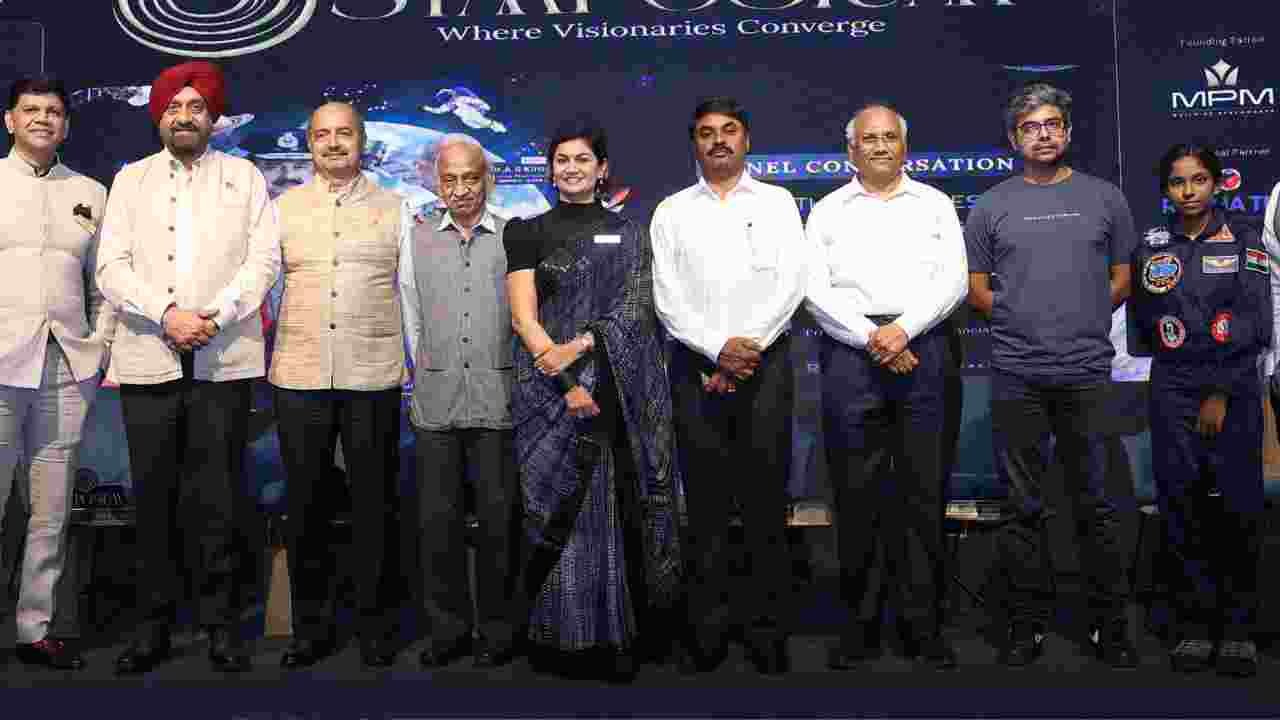
Hyderabad, May 31: India possesses world class space and defence technologies but must rapidly expand launch capacity, private sector participation and policy support to emerge as a global leader in the era of space driven warfare, leading scientists and defence experts said at a high level symposium in Hyderabad.
The consensus emerged during the third edition of the Symposium titled “The Day the Sky Goes Dark: Warfare in the Age of Satellite Dependence”, held at T Hub on Friday.
The event brought together former ISRO Chairman Dr A S Kiran Kumar, former DRDO Chairman Dr G Satheesh Reddy, former Chief of Air Staff Air Chief Marshal Vivek Ram Chaudhari, Ananth Technologies CMD Dr Subba Rao Pavuluri, TakeMe2Space Founder and CEO Ronak Kumar Samantray and retired Lt Gen PJS Pannu.
Opening the discussion, Symposium Founder Girish Mallpani raised a key question that shaped the evening’s deliberations: “Why can’t India build its own Starlink?”
Space Capacity Key to Future Security
The speakers agreed that India’s challenge is not technological capability but capacity building.
Dr Kiran Kumar said India has already demonstrated its technological strength through missions such as Chandrayaan, Mangalyaan, Aditya L1 and Mission Shakti. However, he stressed the need for larger satellite constellations, more launch vehicles and greater private sector involvement.
“India has the capability. The challenge now is capacity. We need not just satellites but constellations and a stronger launch pipeline,” he said.
Dr Satheesh Reddy observed that space has become the fourth dimension of warfare and emphasized stronger collaboration between government agencies and private industry to accelerate growth.
Dr Subba Rao Pavuluri said satellites should now be viewed as integral components of modern weapon systems. He added that the Indian private sector already possesses the engineering and manufacturing capabilities needed to compete globally.
“The demand for defence specific satellites is increasing rapidly. Indigenous satellite production is essential for national security and strategic autonomy,” he said.
Future Wars May Begin in Space
Ronak Kumar Samantray stressed that countries capable of launching satellites quickly and repeatedly would dominate the future space economy.
“We need more rockets,” he remarked, highlighting launch frequency as a strategic advantage.
Former Air Chief Marshal Vivek Ram Chaudhari said information dominance has become as important as conventional firepower. He noted that the ability to rapidly restore damaged satellite networks during conflict may prove more important than the size of existing satellite fleets.
Moderating the discussion, Lt Gen PJS Pannu urged India to move beyond domestic requirements and become a global provider of space technologies and services.
“Why limit our ambition to India? We should aspire to serve the world, shape space diplomacy and ensure India’s sky never goes dark,” he said.
He also stressed that future defence networks would increasingly depend on space based capabilities, cyber systems, resilient communications infrastructure, secure data centres and smart satellites.
Call for Procurement Reforms
Participants highlighted the need for structural reforms in India’s defence and space sectors.
They noted that nearly 90 percent of defence and civilian space procurement in the United States and Europe is routed through private industry. Speakers called for larger procurement opportunities, steady order flows and easier access to growth capital for Indian companies.
One of the highlights of the symposium was the participation of 13 year old Iniya Pragati Martian, India’s youngest Analog Astronaut and a commercial astronaut candidate, symbolizing the next generation of Indian space leadership.
The event also saw the submission of a white paper from the previous symposium edition by Girish Mallpani and Symposium CEO Asha Vashist to Jayesh Ranjan, Special Chief Secretary, Government of Telangana.
More than 100 participants from the defence, aerospace, startup, academic, research and public policy sectors attended the invitation only event.
The key message from the symposium was clear: India does not face a technology gap in space. The country must now address challenges related to scale, capital investment and policy support to become a global leader in the space age.
Now you can get the latest stories from Indtoday on Telegram every day. Click the link to subscribe. Click to follow Indtoday’s Facebook page, Twitter, and Instagram. For all the latest Hyderabad News updates and Follow us on GoogleNews
More Stories…
Haji Salim Network Faces Route Pressure After Lakshadweep Drug Seizure
Haji Salim network faces increased coastal surveillance after a Rs 3,000-crore drug seizure near Lakshadweep.